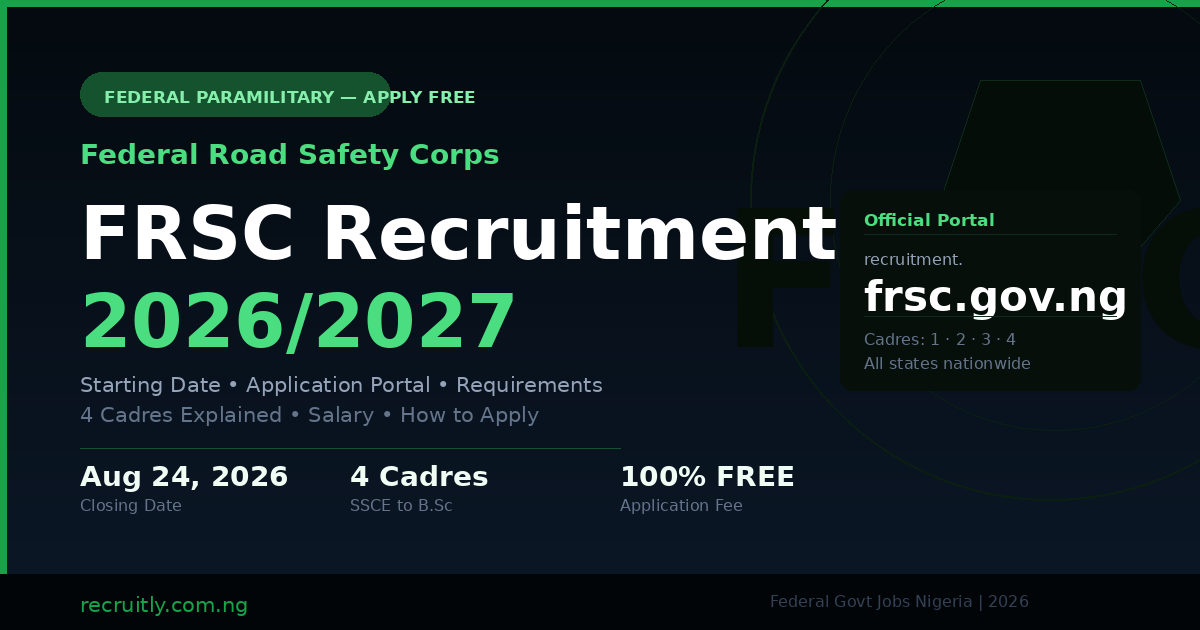

The FRSC Recruitment 2026/2027 is one of the most searched government job opportunities in Nigeria right now, and for good reason. Every year, thousands of Nigerians — from fresh SSCE holders to university graduates — line up to join the Federal Road Safety Corps. The application is free, the salary is government-backed, and the career path is structured and stable. But a lot of people still get their applications rejected or fall for fake portals because they didn’t get accurate information before applying. This guide fixes that. You’ll find the official portal link, the real starting and closing dates, the four cadres explained clearly, salary figures, and a step-by-step application walkthrough — everything you need to apply correctly the first time.
What Is FRSC and Why Their Recruitment Matters in 2026
The Federal Road Safety Corps — FRSC — is Nigeria’s lead federal agency for road safety management and traffic control. If you’ve ever seen uniformed officers at highway checkpoints, managing accidents, or educating motorists on safe driving, those are FRSC officers. The agency operates under the federal government and has a presence in all 36 states plus the FCT.
The Core Mandate of the Federal Road Safety Corps
FRSC’s job isn’t just handing out tickets. The agency handles driver’s license administration, road traffic regulation, accident data management, public road safety education, and enforcement of traffic laws across the country. It’s a full-scale federal paramilitary agency with a structure, rank system, and salary framework comparable to the Nigeria Police Force and the Nigeria Security and Civil Defence Corps.
Joining FRSC means entering a career with a clear promotion ladder, government pension, housing and transport allowances, and the kind of job security that private sector roles simply can’t match. That’s why FRSC recruitment consistently attracts hundreds of thousands of applicants every cycle.
FRSC Recruitment 2026 — Latest Status and Starting Date
Has the FRSC Recruitment Portal Opened?
Yes — the FRSC 2026 recruitment exercise is active. The official portal at recruitment.frsc.gov.ng has been open for applications, and the Federal Road Safety Corps has invited qualified Nigerian citizens to apply for positions across multiple cadres. The application is done entirely online, and there is no paper form to submit anywhere.
If you’ve been waiting to apply, don’t wait any longer. The portal is live now and applications are being processed on a rolling basis.
Expected Starting Date and Closing Date
The 2026 FRSC recruitment exercise opened earlier this year. The confirmed closing date for the 2026 application window is August 24, 2026. Applications submitted after this date are not processed — and there are no extensions. The portal doesn’t have a grace period.
One important note: portal traffic spikes massively in the final week before the deadline. Many applicants run into slow loading times, upload failures, and session timeouts when everyone rushes to apply at the last minute. Submit your application as early as possible to avoid these technical problems.
The Four FRSC Cadres — Which One Is Right for You?
This is where most guides fail you. They list requirements without explaining what each cadre actually means and which one matches your qualification. FRSC recruitment is structured into four cadres, and you must apply to the correct one. Applying to the wrong cadre — even if you’re over-qualified — can disqualify your application outright.
Cadre 1 — Superintendent Cadre (Graduates and HND Holders)
This is the highest entry-level cadre. It’s for candidates who hold a university Bachelor’s degree (B.Sc) or a Higher National Diploma (HND) from an accredited institution. Officers entering at this cadre begin at the Superintendent rank level and take on roles in strategic planning, enforcement management, administration, and policy implementation.
If you’ve completed a B.Sc or HND, this is your cadre. Don’t apply below it — you’ll be under-positioned and waste your qualification advantage.
Cadre 2 — Inspectorate Cadre (OND and NCE Holders)
The Inspectorate Cadre is for candidates with an Ordinary National Diploma (OND) or a National Certificate of Education (NCE) from a recognized institution. Officers at this level typically work in direct road safety operations, including traffic control, accident response, and public education programs.
This cadre sits between the graduate entry level and the SSCE entry levels. If you have an OND or NCE, this is where you belong.
Cadre 3 — Sergeant Cadre (SSCE Holders with Trade Skills)
The Sergeant Cadre is a mid-entry level for SSCE holders who also possess specific trade skills. This includes candidates with valid driver’s licenses, vehicle maintenance skills, or other technical trade qualifications. The sergeant cadre handles more specialized operational duties that require hands-on technical knowledge beyond basic traffic enforcement.
Cadre 4 — Road Marshal Assistant Cadre (SSCE Holders)
This is the entry-level cadre and the most accessible. It’s open to candidates who hold a Senior Secondary School Certificate from WAEC, NECO, GCE, or NABTEB, with a minimum of five credit passes including English Language and Mathematics in not more than two sittings. No degree, diploma, or tertiary qualification is required.
Road Marshal Assistants work on the front lines — traffic enforcement, checkpoint duties, accident scene management, and road safety education at the grassroots level. It’s a demanding role that comes with full FRSC benefits from day one.
FRSC Recruitment 2026 Requirements — Full Breakdown
General Eligibility Requirements for All Cadres
Regardless of which cadre you’re applying to, every FRSC applicant must meet these baseline requirements:
You must be a Nigerian citizen by birth. You must have a valid National Identification Number (NIN). You must be physically and mentally fit and free from any health condition that would impair your duties. You must have no criminal record and no previous dismissal from any government service. Computer knowledge is an added advantage across all cadres. Applicants with driving skills and a valid driver’s license are given preference for roles that involve vehicle operation.
Height Requirements — What You Must Know
FRSC is a paramilitary agency and height is a firm requirement — not a suggestion. You will be measured during the physical verification stage, and there’s no appeal process if you fall below the standard.
Male applicants must be at least 1.69 metres tall (approximately 5 feet 6 inches). Female applicants must be at least 1.65 metres tall (approximately 5 feet 4 inches). Some sources cite slightly varying figures (1.68m for males, 1.63m for females) depending on the cadre — but as a safe rule, use 1.69m and 1.65m as your benchmark.
Don’t show up to the physical verification stage without knowing your actual height. Measure yourself accurately at home before you even submit your application.
Educational Qualifications by Cadre
Here’s how education maps to each cadre:
Superintendent Cadre: B.Sc or HND from a recognized institution
Inspectorate Cadre: OND or NCE from a recognized institution
Sergeant Cadre: SSCE with trade skills or technical certification
Road Marshal Assistant Cadre: SSCE with minimum five credits in not more than two sittings from WAEC, NECO, GCE, or NABTEB — must include English Language and Mathematics
For the Superintendent and Inspectorate cadres, your degree or diploma must also be accompanied by a valid NYSC Discharge Certificate or Exemption Letter if you’re a B.Sc or HND holder.
Physical and Medical Fitness Requirements
You must be medically sound and free from any condition that would prevent you from performing field duties. During the medical examination stage, FRSC checks for vision, hearing, cardiovascular fitness, and the absence of conditions like flat feet, knock knees, and bowlegs. These conditions — common physical disqualifiers across Nigerian paramilitary agencies — will be assessed during screening.
FRSC Salary Structure 2026 — How Much Will You Earn?
FRSC salaries are paid under the Consolidated Paramilitary Salary Structure (CONPASS) — the same framework that governs salary across Nigeria’s paramilitary agencies. Here’s a realistic breakdown of what to expect at entry level in 2026:
Monthly Pay by Cadre and Entry Level
SSCE Holders (Road Marshal Assistant): Entry rank of Road Safety Assistant III or II — approximately ₦30,000 to ₦40,000 monthly basic salary
OND/NCE Holders (Inspectorate Cadre): Starting rank equivalent — approximately ₦40,000 to ₦60,000 monthly basic salary
HND/B.Sc Graduates (Superintendent Cadre): Entry at Assistant Road Corps Commander or Road Corps Commander level — approximately ₦80,000 to ₦120,000 monthly basic salary
Experienced officers and postgraduate degree holders entering at higher officer ranks may start above ₦120,000 depending on years of verified experience.
Allowances and Benefits Beyond Basic Salary
The basic salary figures above don’t tell the full story. FRSC officers receive a range of allowances that significantly boost their total monthly take-home:
Transport Allowance covers commuting and official travel costs. Housing Allowance covers accommodation for officers not in government quarters. Uniform Allowance is paid for uniform replacement and maintenance. Medical coverage extends to the officer and immediate family members. Risk and Hazard Allowance is paid to field officers in enforcement duties. Shift Allowance is paid to officers working night or extended rotations.
Combined, these allowances can add 30 to 50 percent on top of the basic salary depending on your rank, duty station, and posting.
All FRSC officers are also enrolled in the Contributory Pension Scheme, meaning a portion of your salary and a matching government contribution go into your pension fund every month for your retirement.
FRSC Application Portal 2026 — The Right Link to Use
The official FRSC recruitment portal is www.recruitment.frsc.gov.ng
That’s the only link you should use. Bookmark it now.
Official Portal vs Fake Websites — How to Tell the Difference
This is critical. Every major government recruitment exercise in Nigeria attracts fraudsters who create copycat websites, WhatsApp groups, and fake portals designed to collect your personal information or money.
Here’s how to spot a fake FRSC portal:
Any website asking you to pay to access the application form is fake. The FRSC application is free at every stage — zero naira, zero kobo. Any website with a URL that isn’t www.recruitment.frsc.gov.ng or www.frsc.gov.ng is unofficial. Unofficial doesn’t necessarily mean fraudulent, but you should always complete your actual application on the government portal, not a third-party site.
Any WhatsApp contact or individual claiming to help you get shortlisted for a fee is a scammer. FRSC has no agents. Shortlisting is done by the system, not by individuals.
If you receive an email claiming you’ve been shortlisted and asking you to pay a “verification fee” or “training fee” before you’ve done the CBT exam — that’s a scam. The real FRSC process doesn’t collect any money from applicants.
How to Apply for FRSC Recruitment 2026 — Step by Step
Documents to Prepare Before You Open the Portal
Gather these before you go anywhere near the application form. Uploading at the last minute while scrambling to find documents is how errors happen:
- Valid NIN slip
- Birth certificate or sworn age declaration
- O’Level result certificate (WAEC, NECO, GCE, or NABTEB)
- Degree, HND, OND, or NCE certificate (where applicable)
- NYSC Discharge or Exemption Certificate (for B.Sc and HND holders)
- Valid driver’s license (where applicable — especially for Sergeant cadre)
- Recent passport photograph (white background, clear face, no glasses)
- Valid government-issued ID (National ID card, international passport, or voter’s card)
Scan everything clearly. Files should be in JPEG or PDF format and not exceed the portal’s specified size limit (usually 200–500KB per file). Blurry or cropped scans are treated as missing documents.
Step-by-Step Application Process
Step 1 — Open your browser and go to www.recruitment.frsc.gov.ng. Do not use any other link.
Step 2 — Click on Register to create a new account. Enter your name, active email address, and phone number. Use an email you check regularly — every correspondence including your shortlist notification will come there.
Step 3 — Log in to your newly created account using the credentials you just set up.
Step 4 — Select your cadre carefully. Read each cadre description against your qualification before clicking. This choice cannot be changed after submission.
Step 5 — Fill in your personal details exactly as they appear on your NIN and certificates. Any mismatch between your NIN name, your birth certificate name, and your certificate name will flag your application for rejection at the verification stage.
Step 6 — Upload all required documents one by one. Verify each upload is clear and complete before moving to the next field.
Step 7 — Review your entire application from the beginning. Check your name spelling, date of birth, cadre selection, and all uploaded files. Take your time — this step matters.
Step 8 — Click Submit. Immediately print your application confirmation slip and save your reference number. You’ll need both at every stage going forward.
What Happens After You Apply — The 3 Selection Stages
Most guides end at “submit your application.” That’s where yours should just be beginning. Here’s what the full FRSC selection process looks like after you click submit:
Stage 1 — Online Application and Shortlisting
After the portal closes on August 24, 2026, the FRSC reviews all submitted applications against the requirements for each cadre. Candidates who meet the requirements are shortlisted. Shortlisted candidates are notified via the email and phone number used during registration, and the shortlist is also published on the official FRSC website at frsc.gov.ng.
If you don’t get an email, check the official website directly — don’t rely on third-party sites claiming to publish the shortlist.
Stage 2 — CBT Screening and What It Covers
Shortlisted candidates sit a Computer-Based Test. This is a timed, multiple-choice examination that typically covers:
Verbal reasoning and comprehension. Numerical aptitude and basic mathematics. General knowledge and current affairs. Road safety regulations and traffic law awareness. Nigerian government and civic education.
Candidates who pass the CBT move to the next stage. Those who don’t are not contacted further. There’s no resit. Prepare in advance — treat this like a serious exam, not a formality.
Stage 3 — Physical Verification and Medical Examination
Candidates who pass the CBT are invited to their state of origin for the physical verification stage. Here, your height is measured, your documents are checked against official databases, and a medical examination is conducted to confirm your physical and health fitness.
Bring original copies of every document you uploaded online. Originals are verified against official records, and candidates found with forged, altered, or mismatched documents are handed over to security agencies.
Common Mistakes That Get Applications Rejected
Learning what not to do is just as important as knowing what to do. These are the most common reasons applications fail:
Applying to the wrong cadre. If you have a B.Sc and you apply for the Road Marshal Assistant cadre, your qualification will look mismatched and your application may be deprioritized. Always apply at the cadre level that matches your highest qualification.
Entering your name differently from how it appears on your NIN. Even a middle name abbreviation can cause a mismatch that flags your application during verification.
Uploading blurry, cropped, or expired documents. Your uploaded certificates must be complete and clearly readable. Test-open every file you upload to confirm it renders properly.
Using a temporary or inactive email address. If you use a friend’s email or an old account you rarely access, you’ll miss your shortlist notification.
Applying through unofficial websites or paying anyone for assistance. The FRSC application is free and conducted solely at www.recruitment.frsc.gov.ng.
Waiting until the last 48 hours before the deadline. Portal congestion is real. Apply now.
FRSC Recruitment 2026 — Frequently Asked Questions
When will the FRSC recruitment form for 2026/2027 be out? The FRSC 2026 recruitment exercise is already active. The application portal at www.recruitment.frsc.gov.ng is open and accepting applications with a confirmed closing date of August 24, 2026.
What is the official FRSC recruitment portal link? The only official portal is www.recruitment.frsc.gov.ng. The main FRSC website is www.frsc.gov.ng. Apply only through these addresses. Any other website asking you to submit your application is unofficial.
Can SSCE holders apply for FRSC recruitment 2026? Yes. SSCE holders with a minimum of five credit passes including English Language and Mathematics in not more than two sittings from WAEC, NECO, GCE, or NABTEB can apply under the Road Marshal Assistant Cadre (Cadre 4).
What is the closing date for FRSC recruitment 2026? The confirmed closing date is August 24, 2026. Applications are not accepted after this date. Do not wait until the last week to apply — portal traffic slows significantly near the deadline.
How much is FRSC salary in 2026? FRSC salaries are paid under the Consolidated Paramilitary Salary Structure (CONPASS). Entry-level SSCE holders earn approximately ₦30,000 to ₦40,000 monthly basic salary, OND/NCE holders earn ₦40,000 to ₦60,000, and graduate and HND officers earn ₦80,000 to ₦120,000 at entry level. Additional allowances for transport, housing, uniform, and hazard significantly increase total monthly earnings.
How many cadres does FRSC have? FRSC has four main recruitment cadres: the Superintendent Cadre for B.Sc/HND holders, the Inspectorate Cadre for OND/NCE holders, the Sergeant Cadre for SSCE holders with trade skills, and the Road Marshal Assistant Cadre for SSCE holders. You must apply at the cadre level that matches your highest educational qualification.
Is there a CBT exam for FRSC recruitment? Yes. Shortlisted candidates sit a Computer-Based Test covering verbal reasoning, numerical aptitude, general knowledge, and road safety and traffic law questions. Pass the CBT to advance to the physical verification and medical examination stage.
Is the FRSC recruitment form free? Yes, the application is completely free at every stage — from registration to the CBT to physical screening. Anyone asking you to pay at any point is a scammer. Report such individuals to the nearest security agency.